
How to Design a Pitch Deck That Wins Saudi and UAE Investors in 2026
There is a moment every founder knows. The investor is across the table. The deck is on the screen. And in the first 90 seconds, they are already forming an opinion about your presentation rather than your business.
In Saudi Arabia and the UAE, that moment carries more weight than it does almost anywhere else in the world. Regional investors, whether a family office in DIFC, a Vision 2030 programme committee in Riyadh, or a VC at a Jeddah accelerator demo day, evaluate pitch decks with a specific set of expectations that most global templates and AI tools are simply not built to meet.
This guide exists to close that gap. By the end of it, you will know exactly what a winning pitch deck looks like for a Saudi or UAE investor, how to structure it slide by slide, what the bilingual design requirement actually means in practice, and what the most common mistakes look like so you can avoid them entirely.
Why Pitch Deck Design Is Different in Saudi Arabia and the UAE
Before we get into structure, it is worth understanding why the regional context changes things, because it changes them significantly.
Saudi Arabia is in the middle of one of the most ambitious economic transformations in history. Vision 2030 has reshaped investor priorities, government funding channels, and the expectations of every stakeholder involved in backing a business. Investors who are connected to the Public Investment Fund ecosystem, government accelerators like Badir, or family offices that have been reoriented around Vision 2030 goals are not evaluating pitch decks the way a Silicon Valley VC does. They are asking different questions: Does this business align with the Kingdom’s strategic priorities? Does the team understand the Saudi market? Is this presentation respectful of the cultural and linguistic context?
The UAE presents a different but equally distinct environment. Dubai and Abu Dhabi attract some of the world’s most sophisticated international capital — investors who have seen decks from London, New York, and Singapore and hold your deck to the same standard. In ADGM and DIFC, the design quality of your presentation sends a signal before you have said a word. A poorly designed deck in that environment communicates that the business behind it has not yet reached the level of seriousness it is claiming.
Both markets share one absolute: the bilingual expectation. We will come back to that in detail.
The 10 Slides Every Saudi and UAE Investor Expects to See

The global best-practice structure for a pitch deck is well-established — problem, solution, market, model, traction, team, financials, ask. But for a Saudi or UAE audience, there are two additional considerations that most global guides miss entirely. Here is the complete structure:
Slide 1 — Cover
Your company name, logo, tagline, and the presenter’s name. Nothing else. A cluttered cover slide is the first sign of a cluttered presentation. For a Saudi audience, the Arabic name of your company should appear alongside the English version from slide one.
Slide 2 — The Problem
One clearly defined problem. Not a list of five adjacent problems you are vaguely addressing. One specific, real, painful problem that your target customer experiences. Use a real example or a statistic. Make it felt before you make it quantified.
Slide 3 — The Solution
How your business solves that problem. One slide, one clear idea. Avoid feature lists — describe the outcome the customer experiences, not the mechanism behind it.
Slide 4 — Market Size
Total Addressable Market, Serviceable Addressable Market, Serviceable Obtainable Market. For a Saudi or UAE investor, this slide should include regional market data specifically — not just global figures applied to the region as a footnote. Saudi-specific market sizing is a meaningful signal to a regional investor.
Slide 5 — Business Model
How you make money, expressed simply. Revenue streams, pricing model, unit economics if available. This is where many founders over-explain. One clear diagram or table is more effective than four paragraphs.
Slide 6 — Traction
What you have already proven. Revenue, users, partnerships, pilots, letters of intent, government MOUs — whatever demonstrates that this business exists in the real world, not just in your projections. For Vision 2030-aligned businesses, a relevant government partnership or accelerator acceptance is a powerful traction signal.
Slide 7 — The Team
Why you. Specific experience that makes this team credible for this specific opportunity. Saudi investors in particular pay significant attention to the team slide — a track record in the Kingdom, regional experience, or relevant institutional credibility carries real weight.
Slide 8 — Vision 2030 or Strategic Alignment (Saudi-specific)
This slide does not exist in global pitch deck templates. For businesses operating in or seeking capital within Saudi Arabia’s Vision 2030 ecosystem, a dedicated slide showing how your business contributes to — or aligns with — the Kingdom’s strategic agenda is not optional. It demonstrates that you understand who you are pitching to and why your business belongs in their portfolio.
Slide 9 — Financials
Three-year projections minimum. Key assumptions stated clearly. Avoid projections that show a hockey stick without explaining the driver of the inflection point. Gulf investors have seen too many optimistic models. Honest, well-reasoned projections build more trust than impressive ones.
Slide 10 — The Ask
How much you are raising, what you will use it for, and what success looks like at the end of this funding round. Specific, quantified, and tied directly to the milestones on your roadmap.
💡 Related reading: The Ultimate Guide to Winning Investor Presentations in Saudi Arabia — a deeper look at the full presentation strategy beyond the deck structure.
The Bilingual Requirement Is Not Optional

This is the point where most global pitch deck advice fails Saudi and UAE founders completely, so it deserves a section of its own.
A bilingual pitch deck is not a translated pitch deck. The difference is fundamental, and investors in the region can tell the difference immediately.
When you take an English pitch deck and send it to a translator, you end up with an Arabic document that reads like a translation, because it is one. The sentence structures are shaped by English logic. The visual layout is fighting against the right-to-left reading direction. The typography is an Arabic font applied to an English layout, which means the visual weight, the line lengths, and the hierarchy all feel wrong to an Arabic reader.
A bilingual pitch deck that is designed from the ground up in both languages simultaneously looks and reads differently. The Arabic version has its own slide layouts — mirrored where necessary, with Arabic-specific typographic decisions, RTL-aware data visualisations, and text that was written in Arabic first rather than translated into it.
For Saudi government-adjacent investors, the Arabic version is often the primary document. For UAE family offices with Arabic-speaking principals, the quality of your Arabic presentation signals how seriously you have invested in representing your business in this market. For an international investor based in DIFC, the bilingual capability signals that you have the cultural intelligence to operate in the region at a serious level.
At Make My Presentations, we design every pitch deck in English and Arabic simultaneously. Neither version is an afterthought. If you want to understand more about what makes AI-generated presentations fall short in this specific respect, read our piece on why AI-generated presentations are losing Saudi investors.
Design Principles That Saudi and UAE Investors Respond To
The content of your pitch deck matters most. But the design quality communicates something before the content is read — it tells the investor how seriously you take the presentation of your own business.
Visual hierarchy over decoration. The most important information on each slide should command the most visual attention. This means size, colour, and placement working together — not competing with each other. A slide where everything is emphasised is a slide where nothing is.
One idea per slide. This is the rule that most founders break most often. Every time you put two ideas on one slide, you force the investor to decide which one to focus on. Make that decision for them by giving each idea its own slide.
Data visualised, not listed. Financial figures and market data belong in charts and tables — not in bullet points. A well-designed bar chart communicates a trend in two seconds. The same data in a bullet list takes twenty seconds and creates less conviction.
Typography that signals professionalism. Font choice communicates brand maturity before anything is read. Geometric sans-serif typefaces — the same category used by serious tech and finance brands — signal that you belong in the same conversation. Decorative or script fonts signal the opposite. For Arabic, the equivalent is a well-chosen modern Arabic typeface rather than a generic system font.
Colour discipline. A palette of two to three colours, applied consistently, reads as a mature brand. A slide deck where every section introduces a new colour reads as a work in progress.
5 Pitch Deck Mistakes That Lose Saudi Investors Before the First Slide
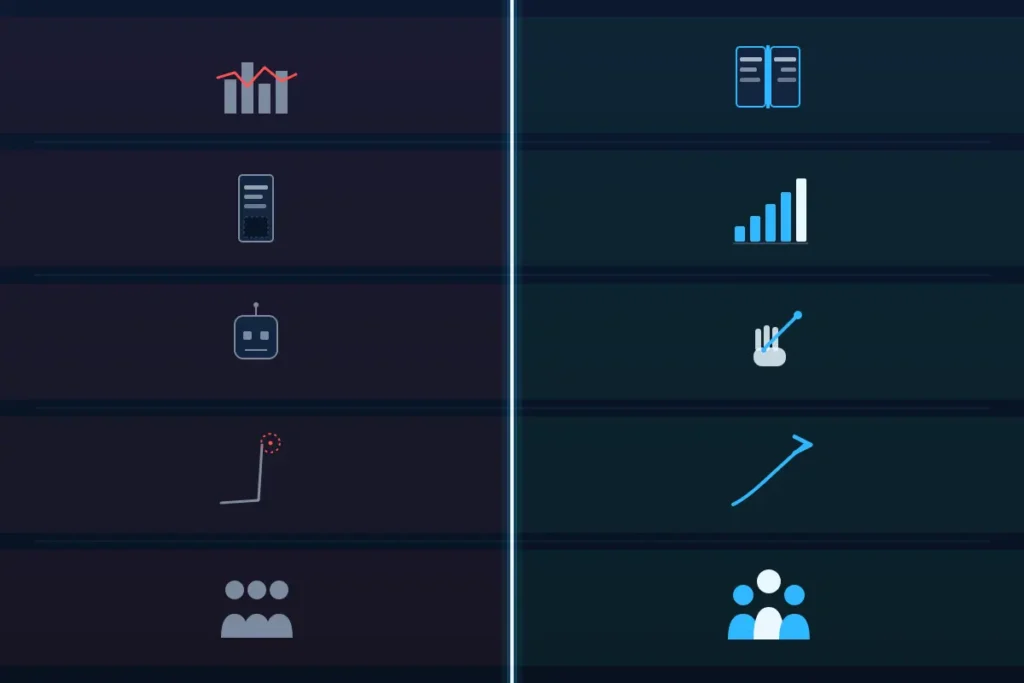
Mistake 1: A global template with no regional context.
Applying a Silicon Valley pitch deck structure to a Saudi or UAE investor meeting without adapting it to the regional context tells the investor that you have not done your homework on who you are pitching to. Vision 2030 alignment, regional market sizing, and cultural awareness are not optional additions — they are the minimum standard.
Mistake 2: English only.
A pitch deck that exists only in English for a Saudi government-adjacent investor audience is an incomplete document. It is not about language preference — it is about demonstrating that you understand the market you are asking someone to back you in.
Mistake 3: AI-generated design.
Investors in Riyadh and Dubai have now reviewed hundreds of AI-generated pitch decks. The aesthetic is recognisable — generic layouts, stock-photo backgrounds, colour schemes that belong to no specific brand, and content that sounds like every other business in your sector. The design quality of your deck reflects the execution quality of your business in the investor’s mind. We cover this in detail in our article on why AI-generated presentations are losing Saudi investors.
Mistake 4: Hockey stick projections without a story.
Showing a revenue curve that goes vertical in year three without explaining the specific driver of that inflection point destroys credibility faster than showing conservative projections. Gulf investors are experienced. They have seen this slide hundreds of times. An honest model with clear assumptions is more fundable than an impressive model with no foundation.
Mistake 5: A weak team slide.
In Saudi Arabia particularly, the team slide carries significant weight. Regional experience, existing relationships within the ecosystem, and a track record in the Kingdom are meaningful signals. If your team has these, the team slide should communicate them specifically — not generically.
When to Work With a Professional Pitch Deck Design Agency
The honest answer is: when the stakes are high enough that the quality of the presentation changes the outcome.
If you are presenting to an investor where the difference between a yes and a no is worth six or seven figures to your business, the cost of professional presentation design is not a significant variable. What is significant is arriving in that room with a deck that communicates your business at its highest level — structurally clear, visually premium, and bilingual.
A professional pitch deck design agency does not just make your slides look better. It restructures your narrative, improves your financial visualisations, ensures your slides work in both Arabic and English, and delivers a final product that tells investors you are serious before you say a word.
If you are based in Riyadh, Jeddah, Dubai, or Abu Dhabi, or pitching to investors in any of these markets — Make My Presentations designs investor pitch decks with a 48-hour first draft and full bilingual delivery. Get a quote and we will come back to you within 24 hours.
Also worth reading: Company Profile vs Corporate Brochure, if you are preparing for investor meetings, understanding which document does which job will save you significant time.
Frequently Asked Questions
About Pitch Deck Design in Saudi Arabia and the UAE
How many slides should a pitch deck have for a Saudi investor?
For most Saudi and UAE investor contexts, a pitch deck should be between 10 and 15 slides. This includes a Vision 2030 alignment slide for Saudi-specific pitches, which is not part of a standard global deck. Pre-seed and seed stage decks should stay closer to 10 slides. Series A and later-stage decks can extend to 12 to 15 slides if the additional content, particularly financial detail and traction evidence, justifies the length. The rule is not the number of slides. The rule is that every slide must earn its place.
Do I need an Arabic version of my pitch deck for Saudi investors?
Yes, in most formal pitching contexts in Saudi Arabia. For government-adjacent investors, Vision 2030 programme committees, and family offices with Arabic-speaking principals, an Arabic version of your pitch deck is expected rather than appreciated. The important distinction is that the Arabic version should be designed bilingually from the ground up — not translated after the fact. A translated pitch deck reads like a translation. A bilingual-designed pitch deck reads like a primary document in both languages.
How long does professional pitch deck design take?
With a specialist agency, a professional pitch deck is typically delivered within 5 to 7 business days from brief confirmation. At Make My Presentations, our standard first draft is ready within 48 to 72 hours. If you have an investor meeting coming up on short notice, contact us directly — we regularly handle urgent briefs and can discuss what is possible within your specific timeline.
What is the difference between a pitch deck and an investor presentation?
The terms are often used interchangeably, but there is a meaningful distinction. A pitch deck is typically the shorter, standalone document — 10 to 15 slides — that is sent to investors before or after a meeting. An investor presentation is the full deck used during the meeting itself, which may be slightly longer and is designed to be presented verbally slide by slide. For Saudi and UAE investor contexts, both documents are expected to be bilingual and to include regional market context. We cover this distinction in more detail in The Ultimate Guide to Winning Investor Presentations in Saudi Arabia.
How much does pitch deck design cost in Saudi Arabia and the UAE?
The cost of professional pitch deck design in Saudi Arabia and the UAE varies based on scope — the number of slides, the level of content strategy involved, and whether bilingual versions are required. At Make My Presentations, we provide a clear quote within 24 hours of receiving your brief. Contact us with your project details and we will give you an accurate estimate the same day, with no obligation.
Can I use AI tools to design my pitch deck for a Saudi investor?
AI tools can generate a slide structure quickly. What they cannot do is understand the regional investor context, design an authentic bilingual deck, apply your specific brand identity with precision, or produce work that looks differentiated in a room where the investor has already seen 50 AI-generated decks. For low-stakes internal presentations, AI tools are practical. For a pitch that needs to perform in front of a Saudi or UAE investor, the design quality sends a signal about the execution quality of your business. We explore this in detail in our article on why AI-generated presentations are losing Saudi investors.