
The Ultimate Guide to Winning Investor Presentations in Saudi Arabia
Saudi Arabia is experiencing one of the most ambitious economic transformations in its history. As innovation accelerates under Vision 2030, entrepreneurs, startups, and established businesses are competing for investment in an increasingly sophisticated market. Capital is available, but so is competition.
Whether you are presenting to venture capital firms, family offices, corporate investors, or strategic partners, one truth remains constant. Your presentation is often the first opportunity to demonstrate how clearly you think, how well you understand your market, and whether your business is ready for growth.
Many founders believe investors make decisions based solely on numbers. Financial projections, market size, and traction certainly matter, but experienced investors also evaluate something less tangible. They assess whether your business can be communicated with confidence and clarity.
That is why an investor presentation is not simply a collection of slides. It is a strategic communication tool that shapes perception long before due diligence begins.
In this guide, we explore what Saudi investors expect, how successful presentations are structured, and the principles that separate memorable pitches from forgettable ones.
Why Investor Presentations Matter More Than Ever in Saudi Arabia
Saudi Arabia has become one of the fastest-growing startup ecosystems in the Middle East. Government initiatives, accelerators, venture capital firms, and corporate innovation programs have created unprecedented opportunities for entrepreneurs across technology, healthcare, logistics, tourism, fintech, and sustainability.
As investment opportunities increase, investor expectations evolve.
A compelling business idea is no longer enough. Investors review dozens of opportunities every month, often making an initial judgment within the first few minutes of a presentation.
The strongest presentations achieve three objectives immediately:
- They communicate the opportunity clearly.
- They demonstrate commercial thinking.
- They inspire confidence in the founding team.
Presentation quality is not about visual polish alone. It is about reducing uncertainty for the people making investment decisions.
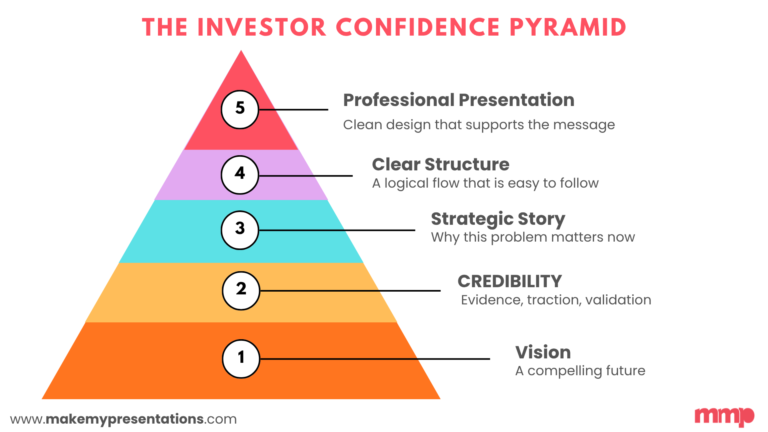
What Saudi Investors Look For Beyond Financial Projections
One of the biggest misconceptions among founders is that investment decisions revolve entirely around revenue forecasts and valuation models.
In reality, experienced investors often ask a different question first:
“Does this team understand its opportunity?”
Your presentation should answer that question before it reaches the financial slides.
A high-performing investor presentation demonstrates:
- A clearly defined market problem
- A differentiated solution
- A realistic understanding of the competitive landscape
- Evidence of customer demand
- A credible growth strategy
- A capable leadership team
The role of presentation design is to make these ideas easier to understand, not to distract from them.
The Ideal Structure of an Investor Presentation
Rather than overwhelming investors with information, structure your presentation as a conversation.
A typical investor presentation includes:
- The problem
- Your solution
- Market opportunity
- Business model
- Product or service
- Competitive advantage
- Go to market strategy
- Financial overview
- Traction and milestones
- Funding request
- Vision for the future
Each section should build naturally into the next, creating momentum instead of forcing investors to connect the dots themselves.
The Three Mistakes That Weaken Investor Presentations
1. Too Much Information
Slides overloaded with text make it difficult for investors to identify what matters most.
Focus on communicating one idea per slide.
2. Designing Before Building the Story
Many businesses begin with colours, icons, and layouts before defining the narrative.
Story first.
Design second.
3. Generic AI Generated Slides
Artificial intelligence can accelerate the drafting process, but investors quickly recognise presentations that lack originality and strategic thinking.
For a deeper look at this topic, read our article on Why AI Generated Presentations Are Losing Saudi Investors.
Why Storytelling Wins More Investment Than Data Alone
Facts explain.
Stories persuade.
The most successful investor presentations combine both.
A strong narrative helps investors understand:
- Why the problem matters
- Why your team is uniquely positioned
- Why the timing is right
- Why your business deserves attention
When storytelling and evidence work together, confidence grows naturally.
Final Thoughts
An investor presentation is one of the most valuable business assets you will ever create. It represents your vision, your strategy, and your ability to communicate complex ideas with clarity.
While design plays an important role, the strongest presentations are built on thoughtful storytelling, logical structure, and a deep understanding of the audience.
If your business is preparing for fundraising, partnership discussions, or strategic growth, investing in a well-crafted presentation can significantly improve how your ideas are received.
FAQs
What should an investor presentation include?
An investor presentation should clearly explain the problem, solution, market opportunity, business model, competitive advantage, financial overview, and funding requirements. The goal is to communicate your business with clarity and confidence.
How long should an investor presentation be?
Most successful investor presentations contain between 10 and 15 slides. Rather than adding more information, focus on presenting the right information in a logical sequence.
Do Saudi investors expect professionally designed presentations?
Yes. While investors prioritise the strength of the business, a professionally designed presentation reflects preparation, attention to detail, and the ability to communicate effectively.
Can AI create a good investor presentation?
AI can help generate initial content or layouts, but it cannot replace strategic storytelling, market understanding, and audience-specific communication. Human expertise remains essential for high-stakes investor presentations.